Blog
Articles, tutorials, and field notes on identity, integration, API management, and application security — spanning nearly two decades of hands-on work.
Articles, tutorials, and field notes on identity, integration, API management, and application security — spanning nearly two decades of hands-on work.
Check out JSR 316 and this article. There is also a Slashdot.org thread on the subject.
Classloaders are responsible for finding and loading classes that are requested in Java code executed inside a Java Virtual Machine. Classloader-related issues are among the most difficult to troubleshoot in the Java/J2EE technology stack.
The older articles predating the use of WordPress are slowly being copied over to the WordPress format. This provides a common look & feel and allows WordPress seach functionality, RSS feeds, and other goodies to work properly with the older content.
I always forget the quantity prefixes above “tera”. Even more interestingly, one rarely thinks about the numbers’ names. For example, consider the number
This article expands on the previous Virtual Memory post by exploring Resident Set Size growth while running a Java program that will consume all available Java Heap memory. Four different JVM implementations are used to compare results of these experiments. These JVMs come from two different…
Google has released a Browser Security Handbook online. It can be found here.
It has been a couple of weeks since the last article was published. Recently, I had to dig into Virtual Memory on AIX to work through some issues. I realized there were several details I needed to explore further to understand Virtual Memory implementations. In particular, the implementation…
In the last article, JAAS was introduced. An authenticated calling-entity (perhaps a user), has a JAAS Subject. This JAAS Subject contains some combination of Principals, Public Credentials, and Private Credentials. It can be very helpful to dump the contents of this JAAS Subject for debugging…
This article introduces JAAS authentication via a relatively simple example. The example presented here is based upon the Sun tutorial of the same subject. The thinkmiddleware.com example extends the tutorial to use LDAP to authenticate users.
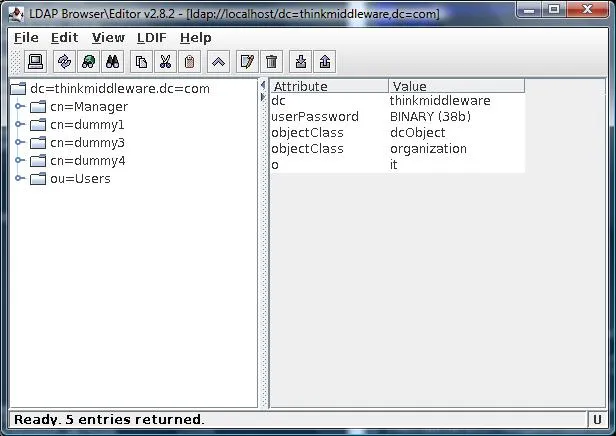
The recent JNDI article and an upcoming JAAS article require an LDAP server. This tutorial will walk through the basic details of reproducing the Openldap Server used in these two articles.
While researching an upcoming JAAS article, the decision was made to use JNDI to interact with the Openldap server that was stored user information. JNDI is used extensively in the J2EE landscape; so, exploring JNDI separately from JAAS seemed in order.
I’ve mentioned that for larger projects/examples on thinkmiddleware.com, Ant would be used. The Java Security Manager article was the first time it was used. Although, the full details of the source code were not included, Ant was used.