Blog
Articles, tutorials, and field notes on identity, integration, API management, and application security — spanning nearly two decades of hands-on work.
Articles, tutorials, and field notes on identity, integration, API management, and application security — spanning nearly two decades of hands-on work.
In the last post, we looked at the steps involved in generating a digital signature using the XML Digital Signature spec. The algorithm to produce a signature and validate it were explored but no examples were given. In this post, we’ll look at an example that is given in the XML Digital Signature…
The XML DSig specification is used to provide digital signature functionality to XML Documents. It is is used by numerous other specs such as WS-Security and SAML2. This blog entry will describe how digital signatures work with an X509 private/public key pair.
I was asked recently what XML, XSD and XSLT editor I use. Given that I am an independent/small consulting firm owner, spending $1000s of dollars on development tooling that will come out of my own pocket is not my first choice.
I’ve talked about authentication many times on ThinkMiddleware.com. It recently occurred to me that I have never devoted a blog post to defining authentication. I’ve had a section on the subject in a couple of different places, but I wanted to have an article to reference from other posts. So, here…
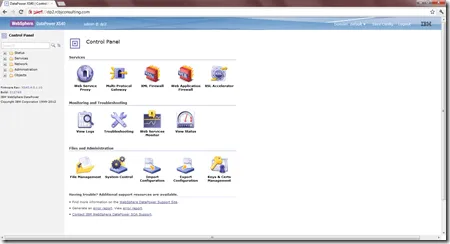
The primary administration automation mechanism on IBM WebSphere DataPower appliances is the XML Management Interface. The XMI interface allows one to make SOMA (SOAP Configuration Management, assuming SOMA = SOap MAnagement) calls to perform various administration tasks. How to perform these…
A few months ago I switched from using Cisco’s QuickVPN software to the ShrewSoft VPN Client for Windows. I’m not going to get into the issues that I had with QuickVPN-it wasn’t very reliable. I’ve had ShrewSoft VPN for Windows v2.1.7 connecting to a Cisco RV082 VPN router. ShrewSoft provides…
In a previous blog post, I listed a number of SOA Specs and Security Specs that I thought were important to be familiar with when working with DataPower and other SOA technologies. In this post, I made a quick (and dirty) Visio diagram that I tend to draw up on a whiteboard when I’m at a new client…
While working with DataPower and Active Directory (acting as the User Repository) I have often run into situation where AD returns an LDAP error code 49 plus a sub-code in the error string that is unique to AD. The sub-code can be very useful to troubleshooting, if you know what it means.
In the last post, we saw how an XML Firewall in loopback mode could be used to return a valid SOAP response to a service message. The stylesheet used simply returned a static SOAP response that was independent of the input parameters. The stylesheet returns a response containing the sum of two…
It is often the case that a DataPower developer will have work to do, but does not yet have a backend Service Provider to point the DataPower service at. In general, anything beyond trivial examples will need to point at something that returns a valid response. In order to satisfy this requirement,…
Another use-case that I touched on during my JBoss World 2012 presentation was using the PicketLink WS-Trust Client implementation to communicate with third-party Security Token Services. In particular, we discussed how the PicketLink SAML2STSIssuingLoginModule can communicate with the IBM Tivoli…
I’ve been at a couple of different client sites where there was a heavy IBM product presence, the use of IBM’s proprietary token format-LTPA2, and the need for a non-IBM technology such as JBoss EAP. Given the nature of the LTPA2 technology (IBM proprietary protocol), there isn’t any direct support…