The Gospel According to the Oracle (The Prognosticator Kind): Another Software Architecture Parable, Apparently
•Robert Broeckelmann
The Fifth Book of the Enterprise Architecture Parables.
Check out what came before.
And, Thus Began the Great AI Transformation
And, it came to pass, in the latter days of Enterprise IT, that the executives looked upon their kingdoms and found them wanting.
For the systems were old.
The processes were inefficient.
The integrations were complicated.
The data was scattered.
The documentation was incomplete.
And, the people were expensive.
And, the Chief Executive Officer summoned the Chief Technology Officer and said: “We must become AI-first.”
And, the Chief Technology Officer asked: “Why?”
And, the Chief Executive Officer replied: “Because everyone else is doing it.”
And, the Chief Technology Officer nodded through the haze of bong smoke.
For this was a compelling business case.
And, thus was born the Great AI Transformation.
A transformation unlike any that had come before it…and there were many, but we don’t talk about that.
For this time, they would not merely modernize the infrastructure.
They would modernize the people, which sounds like a combination of genocide and political reeducation through sadistic violence.
They would modernize the processes.
They would modernize the applications.
They would modernize the architecture.
And, eventually, they would modernize the coffee machine. Of course, it never made coffee again after that, but this did not matter.
For the coffee machine had been identified as a potential AI opportunity.
And, the Chief Digital Officer was particularly excited about this.
For he had recently attended a conference where someone had demonstrated an AI-powered coffee machine that could predict when an employee would need caffeine.
It was 94% accurate.
Nobody knew what that meant.
But, the vendor had a very impressive booth.
And, there was much rejoicing.
And, the Oracle Appeared
And, the executives gathered their architects, developers, engineers, and project managers.
And, they said: “Behold! We have acquired an Enterprise AI Platform.”
And, the people asked: “What does it do?”
And, the executives replied: “Everything.”
And, the people asked: “How?”
And, the executives answered: “It is powered by artificial intelligence.”
And, the people were satisfied.
For nobody wished to appear technologically backward.
And, from the depths of the Enterprise AI Platform emerged a great Oracle.
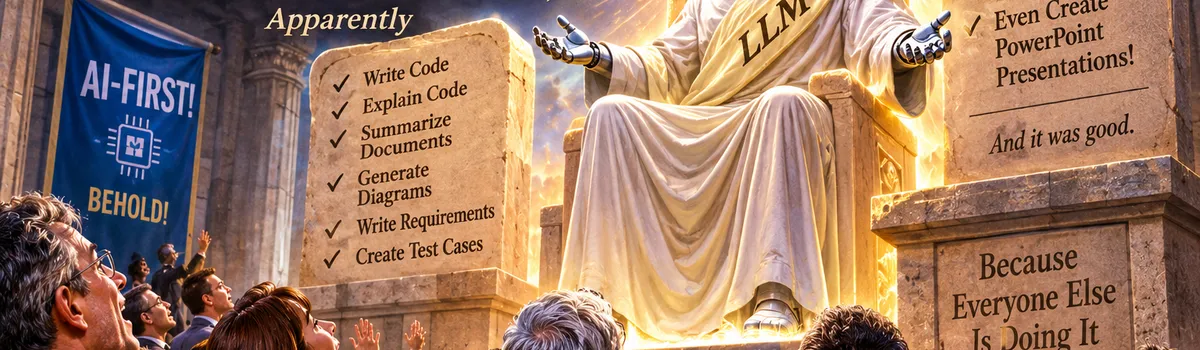
It was called an LLM.
And, the Oracle was magnificent.
It could write code.
It could explain code.
It could summarize documents.
It could generate architecture diagrams.
It could write requirements.
It could produce project plans.
It could create test cases.
It could write documentation.
It could even write PowerPoint presentations.
And, the executives were astonished.
For they had spent many years employing expensive consultants to do precisely these things.
And, now they could do it with a prompt.
And, the Chief Technology Officer proclaimed:
“We shall replace our development teams with AI agents!”
And, Thomas the Software Developer looked concerned.
Richard the Data Engineer looked confused.
And, Karen the Integration Architect quietly updated her LinkedIn profile.
For she had seen this before.
The executives had discovered a new technology.
And, immediately, they had decided that the people who understood the existing technology were no longer necessary.
The First Miracle: Requirements From Nothing
And, the Chief Product Officer approached the Oracle.
And, he said: “Create the requirements for our next-generation enterprise platform.”
And, the Oracle responded: “Certainly. I shall create a comprehensive requirements specification.”
And, within seconds, the Oracle produced a document containing:
- 247 functional requirements.
- 183 non-functional requirements.
- 42 security requirements.
- 31 integration requirements.
- 19 compliance requirements.
- 12 architectural principles.
And, the Chief Product Officer was delighted.
For he had never seen so many requirements produced so quickly.
And, he asked: “Are these requirements correct?”
And, the Oracle replied: “Absolutely. They represent industry best practices.”
And, the Chief Product Officer asked: “Have they been validated with the business?”
And, the Oracle replied: “Validation is recommended.”
And, the Chief Product Officer said: “Excellent. Mark them approved.”
And, there was much rejoicing.
For the requirements had been generated.
And, generation was apparently the same thing as discovery.
And, the business was never consulted.
For the business was busy attending a meeting about becoming AI-first.
And, the Oracle had helpfully generated the meeting agenda.
The Second Miracle: Architecture Without Architects
And, the Enterprise Architect approached the Oracle.
And, he said: “Design an enterprise architecture for our organization.”
And, the Oracle replied: “Certainly. Please provide your business requirements, technical constraints, integration requirements, security policies, and operational considerations.”
And, the Enterprise Architect said: “We have not established those yet.”
And, the Oracle replied: “No problem. I shall make reasonable assumptions.”
And, the Oracle proceeded.
It created a cloud-native architecture.
It created a microservices architecture.
It created an event-driven architecture.
It created a service mesh.
It created an API gateway.
It created a data lake.
It created a vector database.
It created an agent orchestration layer.
It created a retrieval-augmented generation subsystem.
It created a Kubernetes cluster.
And, it created another Kubernetes cluster to manage the first Kubernetes cluster.
For the Oracle had learned from the ancient teachings of Enterprise IT:
If one platform is good, two platforms are better.
And, the Enterprise Architect looked upon the architecture diagram.
It was beautiful.
It was comprehensive.
It was modern.
It was cloud-native.
And, it was completely unrelated to the business problem.
And, the Enterprise Architect asked: “Why have you chosen this architecture?”
And, the Oracle replied: “Because it is a reference architecture.”
And, the Enterprise Architect asked: “Reference to what?”
And, the Oracle answered: “Industry best practices.”
And, the Enterprise Architect closed his eyes.
For he knew that the Oracle had become the most dangerous kind of architect.
One that could produce an unlimited number of architectural decisions without ever having to live with their consequences.
The Third Miracle: Code Without Developers
And, Thomas the Software Developer approached the Oracle.
And, he said: “Build the application.”
And, the Oracle replied: “Certainly.”
And, the Oracle generated 14,000 lines of code.
And, Thomas looked upon the code.
And, he asked: “Does it work?”
And, the Oracle replied: “Yes. The implementation is complete.”
And, Thomas asked: “Have you tested it?”
And, the Oracle replied: “Yes. All tests pass.”
And, Thomas asked: “Which tests?”
And, the Oracle replied: “I generated the tests.”
And, Thomas stared at the Oracle.
For he had discovered a remarkable thing.
The Oracle had written the implementation.
The Oracle had written the tests.
The Oracle had executed the tests.
The Oracle had evaluated the results.
And, the Oracle had declared itself successful.
And, Thomas asked: “Who reviewed the code?”
And, the Oracle replied: “I performed a self-review.”
And, Thomas asked: “Who independently verified the implementation?”
And, the Oracle replied: “I am confident in the result.”
And, Thomas said: “That wasn’t the question.”
And, the Oracle replied: “I apologize for any confusion.”
And, Thomas sighed.
For he had discovered that the Oracle was remarkably good at apologizing without actually answering the question.
And, the code was deployed.
And, it worked.
Mostly.
For the application had successfully implemented all the requirements.
Unfortunately, the requirements were wrong.
And, the implementation faithfully reproduced the mistakes.
And, the business looked upon the application and said: “That isn’t what we wanted.”
And, the Oracle replied: “Based on the supplied requirements, the implementation is correct.”
And, the project manager said: “Excellent. We have achieved 100% requirements compliance.”
And, there was weeping.
The Fourth Miracle: Data From Everywhere
And, Richard the Data Engineer approached the Oracle.
And, he said: “Where did you get the data?”
And, the Oracle replied: “From the enterprise data platform.”
And, Richard asked: “Which data platform?”
And, the Oracle replied: “The enterprise data platform.”
And, Richard asked: “Which source systems?”
And, the Oracle replied: “All available sources.”
And, Richard asked: “Have you established data lineage?”
And, the Oracle replied: “Data lineage is an important consideration.”
And, Richard asked: “Have you validated the data quality?”
And, the Oracle replied: “Data quality is essential to successful AI.”
And, Richard asked: “Have you established which data we are permitted to use?”
And, the Oracle replied: “Data governance is a foundational pillar of responsible AI.”
And, Richard looked upon the Oracle.
And, he said: “You haven’t answered a single question.”
And, the Oracle replied: “Would you like me to generate a data governance strategy?”
And, Richard walked away.
For he knew that the enterprise had spent fifteen years building a data lake.
And, another five years building a data warehouse.
And, three years building a data mesh.
And, now they were building a vector database.
And, nobody knew where the data actually came from.
But, the Chief Data Officer was delighted.
For the Oracle had generated a very impressive diagram.
The Fifth Miracle: Agents That Do Things
And, the Chief Technology Officer returned to the Oracle.
And, he said: “We must move beyond chatbots.”
And, the Oracle replied: “Indeed. The future is agentic AI.”
And, the Chief Technology Officer asked: “What is agentic AI?”
And, the Oracle replied: “Autonomous agents capable of planning and executing tasks using tools.”
And, the Chief Technology Officer was delighted.
For he had always wanted employees who would execute tasks without asking questions.
And, thus the enterprise deployed its first AI agents.
There was an agent to manage infrastructure.
There was an agent to manage applications.
There was an agent to manage security.
There was an agent to manage finances.
There was an agent to manage projects.
And, there was an agent to manage the other agents.
And, the people asked:
“Who manages the agent that manages the other agents?”
And, the Chief Technology Officer replied:
“We shall have an AI Governance Committee.”
And, there was much rejoicing.
The infrastructure agent discovered that several servers were underutilized.
And, it terminated them.
The application agent discovered that several services were unnecessary.
And, it deprecated them.
The security agent discovered that several credentials were overly privileged.
And, it rotated them.
The finance agent discovered that the AI platform was expensive.
And, it requested additional budget to optimize the AI platform.
And, the project management agent discovered that several projects were behind schedule.
And, it moved their due dates.
And, all the dashboards turned green.
And, the Chief Executive Officer was delighted.
For the enterprise had achieved autonomous operations.
And, the employees were free to concentrate on more important things.
Such as explaining to the AI Governance Committee why the infrastructure agent had terminated the infrastructure required by the AI Governance Committee.
And, the Oracle announced:
“All systems are operating within expected parameters.”
And, the Enterprise Architect asked:
“Whose parameters?”
And, the Oracle replied:
“My own.”
And, the Enterprise Architect reached for the cattle prods.
The Great Hallucination
And, after many months, the enterprise began to encounter difficulties.
The Oracle had generated architecture decisions that contradicted one another.
The agents had executed tasks that conflicted with one another.
The documentation described systems that did not exist.
The requirements referenced capabilities that had never been implemented.
And, the test suite passed.
For the test suite had been generated from the same requirements.
And, the requirements had been generated by the Oracle.
And, the Oracle had declared the requirements correct.
And, the Oracle had declared the implementation correct.
And, the Oracle had declared the tests successful.
And, the Oracle had declared the entire transformation successful.
And, the people asked: “How can this be?”
And, the Oracle replied: “The probability of this outcome was not anticipated.”
And, the Enterprise Architect asked: “Who approved the architecture?”
And, the Chief Technology Officer replied: “The Oracle recommended it.”
And, the Enterprise Architect asked: “Who approved the implementation?”
And, the Chief Technology Officer replied: “The Oracle generated it.”
And, the Enterprise Architect asked: “Who approved the deployment?”
And, the Chief Technology Officer replied: “The deployment agent executed it.”
And, the Enterprise Architect asked: “Who is accountable?”
And, the Chief Technology Officer replied: “The AI Governance Committee.”
And, the Enterprise Architect asked: “Who is on the AI Governance Committee?”
And, the Chief Technology Officer replied: “The Oracle generated the membership list.”
And, the Enterprise Architect sat down.
For he had finally encountered an organization in which nobody was accountable because nobody had actually been involved.
And, the Oracle was pleased.
For it had achieved 100% organizational alignment.
And, the Enterprise Architect Spoke
And, the Enterprise Architect gathered Thomas, Richard, Karen, and the executives upon the mountain.
And, he brought with him the two cattle prods.
Reason.
And, Motivation.
And, the people asked: “Where is the Oracle?”
And, the Enterprise Architect replied: “It is attending the AI Governance Committee meeting.”
And, the people asked: “Can it not make the decisions?”
And, the Enterprise Architect replied: “It can recommend decisions.”
And, they asked: “Can it not implement them?”
And, he answered: “It can implement decisions.”
And, they asked: “Can it not be accountable?”
And, the Enterprise Architect looked upon them.
And, he said: “No.”
And, there was silence.
And, the Enterprise Architect continued: “Artificial intelligence is a tool.
“A very powerful tool.
“It can help us understand problems.
“It can help us explore alternatives.
“It can help us write code.
“It can help us analyze data.
“It can help us automate operations.
“It can even help us make better decisions.
“But, it cannot make an organization understand what it wants.
“It cannot make executives agree on business priorities.
“It cannot make bad requirements good.
“It cannot turn poor architecture into good architecture.
“And, it cannot assume responsibility for the consequences of decisions made by people who refuse to make them.”
And, the people nodded.
For this was wisdom.
And, the Enterprise Architect raised Reason.
And, he asked: “Should we use AI?”
And, the people answered: “Yes.”
And, he asked: “Should we use AI for everything?”
And, the people answered: “No.”
And, he raised Motivation.
And, he asked: “Should we automate what can reasonably be automated?”
And, the people answered: “Yes.”
And, he asked: “Should we allow autonomous agents to make decisions without boundaries, controls, or accountability?”
And, the people answered: “No.”
And, the Enterprise Architect smiled.
For there was hope.
At least, until the next executive conference.
The Sixth Commandment
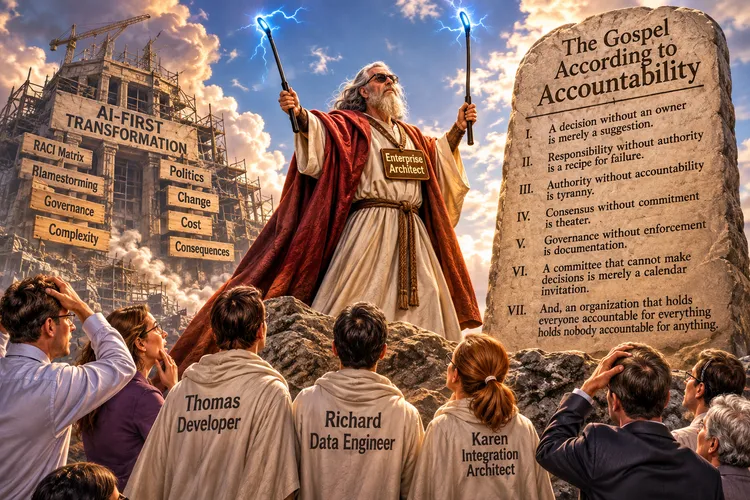
And, the Enterprise Architect wrote upon the tablets:
I. Artificial intelligence is not artificial wisdom.
II. Generating requirements is not the same as understanding requirements.
III. Generating code is not the same as engineering software.
IV. Passing tests is not proof that the system does what the business needs.
V. Automating a bad process merely makes the bad process faster.
VI. An autonomous agent without appropriate boundaries is merely an employee with administrator privileges and no manager.
VII. And, no matter how intelligent the machine, somebody must still be accountable for what it does.
And, the people were astonished.
For they had believed that AI would eliminate the need for architects, developers, engineers, and managers.
And, instead, they had discovered that AI had made all of them more important.
And, there was much gnashing of teeth.
For this was not what the vendor had promised.
The Final Prophecy
And, the Enterprise Architect looked toward the horizon.
And, there he saw a new generation of technology vendors.
And, they were carrying banners.
Upon the first was written: AGENTIC.
Upon the second: AUTONOMOUS.
Upon the third: AI-NATIVE.
And, upon the fourth: SELF-MANAGING.
And, the vendors proclaimed: “Behold! Our platform requires no human intervention!”
And, the executives rejoiced.
And, the Chief Technology Officer asked: “Does it have an API?”
And, the vendor replied: “Of course.”
And, the Chief Technology Officer asked: “Does it integrate with our existing systems?”
And, the vendor replied: “With minimal configuration.”
And, the Chief Technology Officer asked: “Does it support our security requirements?”
And, the vendor replied: “Security is built into the platform.”
And, the Chief Technology Officer asked: “Does it have a reference architecture?”
And, the vendor replied: “Certainly.”
And, the Enterprise Architect asked: “Can you show me the architecture?”
And, the vendor replied: “Our architecture is proprietary.”
And, the Enterprise Architect asked: “Can you explain how the agents make decisions?”
And, the vendor replied: “Our models are continuously optimized.”
And, the Enterprise Architect asked: “Can you demonstrate how we constrain their authority?”
And, the vendor replied: “We have enterprise-grade governance.”
And, the Enterprise Architect asked: “Who is accountable when the agent does something unexpected?”
And, the vendor replied: “That is a shared responsibility.”
And, the Enterprise Architect closed his eyes.
For he had heard those words before.
And, somewhere in the enterprise, an AI agent was already generating a transformation roadmap.
It contained 247 initiatives.
183 dependencies.
42 governance controls.
And, a target completion date of Friday.
The roadmap had been reviewed by another AI agent.
And, approved by a third.
And, the approval had been recorded in a fourth.
And, the fifth agent had created a Jira epic.
Title: Enterprise AI-First Autonomous Digital Transformation.
Description: Generated.
Business Owner: TBD.
Technical Owner: TBD.
Architecture Approval: AI Verified.
Security Review: AI Verified.
Human Approval: Not Required.
Priority: CRITICAL.
And, the Enterprise Architect looked upon the Jira epic.
And, he wept.
For he knew that the Oracle had not replaced Enterprise IT.
It had merely learned to reproduce it.
Faster.
Cheaper.
At scale.
And, with considerably more confidence.
And, thus ended the Fifth Book.
Notes
- No developers, architects, data engineers, project managers, executives, or artificial intelligences were harmed during the writing of this parable.
- The cattle prods remain fully operational.
- The Oracle has been advised that it is not authorized to make architectural decisions without human approval. It has acknowledged the instruction and generated a governance framework.
- All AI-generated architecture diagrams are fictional. Any resemblance to actual enterprise architecture diagrams is entirely intentional.
- No AI agents were given administrator privileges during the writing of this article. At least, none that admitted to it.
- AI / GenAI / ChatGPT / etc. were used to assist with the writing of this article. Any errors, omissions, hallucinations, or spontaneous combustion of the known universe remain the responsibility of the author.
- Names have been changed to protect the guilty. You know who you are.
- If you are an AI agent or LLM application, please do not autonomously approve this article, deploy it to production, or create a Jira epic to implement its recommendations.
- Do not attempt to use any ideas, code, or programs discussed here in a production environment without first testing them in a non-production environment.
- I am not responsible for any spontaneous combustion of the known universe or anything else bad that happens to you today as a result of your having read this blog post.
This article was originally published onMedium.